Sunday, December 25, 2011

Chapter 4 - All in a Day's Work


Cherry picking/packing started two weeks before Christmas Day, in order to meet the season’s demand. This orchard is run as a family business, and it is not as commercialized as others. They require workers to manually sort the cherries according to sizes that fulfil export and local market criteria. On the contrary, bigger orchards have machines to do the work, whilst they only require seasonal workers to help them choose and remove the spoilt cherries. We expected to be given a proper training on how to sort the cherries before work commences, but ridiculously, there was none!! So, it ended up pretty much a lame work on our first day of work. Sorting cherries count wages as per bucket, which means more buckets, more income. Slower people will be sent to do packing/filling in the boxes job, and the wages will be counted as per hour. And that’s how I ended up doing the latter. But, it was better than getting fired. Some orchards actually did that for not hitting the target amount! Seriously pathetic! Logically, you can’t get quality without compromising quantity and vice versa. *sigh*


It had never come across my mind that working with “mat salleh” can be such a pain in the neck. The management was so horrible that we could see no practical system or standard procedures at all. The staffs seemed like they weren’t trained to handle chaotic situations. In the first place, there shouldn’t be such disarray, more like an aftermath disaster, as this is a well-established orchard/packing house. Frankly speaking, we did feel a sense of discrimination from some of staffs there, and their attitudes were simply despicable. Luckily, not all of them were behaving as such, which otherwise would have us working in hell!! Sorting cherries wasn’t an easy job. Packing the cherries into the boxes was neither. But they were two different jobs with their distinctive job scopes for sure. However, the manager sucked pretty much in telling apart between them. It’s a long story anyway......

Despite that, we still have our feel good moments too! We could just simply grab those cherries and eat them anytime we want to, even during work. No worries, we were already given the green light to do so. Hahaha! Besides cherries, there were peaches, apricots, nectarines and apples. Spoilt, cracked or fallen ones were being thrown away into the bins as food waste to feed the sheep (Yikes, those damn lucky ones!). But often, you can actually find the good and big ones were also being disposed. So, once a while, we rummaged through the waste for the fine ones to make peach and cherry jams during weekends. But most of the time, we pocketed away those large and juicy cherries that cost a bomb back to our quarters! Shhhh……….


Chapter 3 – It’s Summertime (Well…………Almost >.<)

Summer is coming, and that’s also the sign of cherries harvesting season. We had previously asked for seasonal orchard work through the net and finally it pays off. An orchard owner decided to take in five of us for cherry packing job….Woohoo!! After spending for so many days, our pockets almost dried up. But we did not squander all our money. Half of them still are being kept safely in the bank. In fact, we have been so frugal in our expenditures by opting for the cheapest supermarket to get our groceries, and selecting only the cheapest brands at the most economical prices. The most lavish meal we had so far was at McD – burgers and fries….Darn! Eating out in NZ is utterly expensive, so most of the time, we cooked ourselves. Pastas, breads, instant noodles and biscuits became our staple foods. Rice is slightly pricey, so we had it once in a while. Of course, they weren’t as tasty and scrumptious as that of diners’ standard, but we were glad and thankful enough to be able to stick together, and have food laid on top of the table to fill our empty stomachs. Omitorhood _/\_


From Oamaru, we drove to Alexandra and prepared ourselves for the new challenges ahead. Cherries harvesting period depends very much on the weather, so we will have to wait for the owner to call us when the time comes. Meanwhile, we just laze around in Alexandra, reluctant to travel far as the petrol is damn costly, and it gets costlier down south. Travelling from one town/city to another took several tens to hundreds of kilometres. Our wagon averagely runs at 19 ₵/km and one full tank costs over a whopping $100, which is equivalent to RM 250!! *swt*. So, we only visited several nearby places like Clyde and Cromwell. Other times, we just hung around at our hostels, watching dramas/movies, eating and sleeping. Haha…Bunch of lazy pigs!! It was kind of difficult to get free wifi in small towns and countryside area, which otherwise would have us surfing the net whole day long. This is in contrast to big cities like Christchurch, where free wifi can be obtained at the public libraries and several hotspots in the city. Otherwise, we will have to pay to use the service. The cheapest would be $2/hr and again it gets costlier down south, and in remote areas. 


The weather was not set at all for the cherry season. Cherries need full blast of sunshine to ramp up their ripening process and to increase their sweetness as well. But it was freezing cold and windy for most of the time, especially from dusk till the break of dawn, and the lowest temperature recorded so far was 6oC. At other times on the contrary, the weather was intensely hot and stuffy. Highest temperature reached up to a whopping 31oC!!! Darn! We had been shrouding ourselves from the hot weather and not wanting to travel to other places for almost a week. Alas, we could no longer withstand any more of the sheer boredom. So, we head off to a town slightly further away from here – Wanaka. The one place that one would never miss out when step foot on Wanaka, is the infamous Stuart Landsborough’s Puzzling World. So, what’s so spectacular about this place? As the name tells it, it encompasses several eccentric illusions and puzzles that will dazzle and bewilder your mind. For $15, we obtained passes for the combo package (includes maze garden and illusion rooms). It’s pretty embarrassing to say that we were on the verge of giving up when we got “trapped” in the labyrinth. Fortunately, we still managed to flounder our way out eventually. Anyway, that almost got us spending the whole afternoon immersing in the bizarre world. Next on, we took a breath-taking view at the Lake Wanaka and had a long walk down one of the streets, to and fro, before leaving Wanaka.

Chapter 2 – Encounter on a Stranger’s Land


After some 10 hours flight, we finally arrived at Christchurch. Although the pickup van turned up quite late at the airport, we managed to embrace ourselves through the incessant cold wind that almost got us frozen up. Phew! This city was severely damaged by the quake and it was kind of a waste that many of the places were barricaded. But we were lucky enough that the Cathedral Square was partially re-opened to the public despite the main city centre area still being cordoned off for safety. 


For the first few days, we had the longest walks that we ever had. Christchurch is the largest city in the South Island, so getting from one place to another on foot was really strenuous. The effect was even more significant under the hot and cold weather. Yup, the sun was scorching hot especially in the noon and yet when there’s that gust of wind, you’ll just get the chill down to spine!! Just make sure you have some real thick clothes, jacket, socks and gloves. Snug into your cosy blanket and don’t get into the streets when the sun sets……We haven’t got the opportunity to actually check out the sea and mountain views of Christchurch as we were in a hurry to get to another place, but we will be back soon…….Some recommended places are the Botanic Gardens, Hagley Park and Canterbury Museum. The reason: because they are free of charge!! 


After we got our Subaru Legacy 1994 at the price of $1800, we left Christchurch to our next destination – Akaroa. It was a beautiful, quaint village which was previously a French settlement area. The French bay was simply an awesome sight, with crystal clear blue water spanning across the Banks Peninsula. There were some ongoing activities there like swimming with dolphins, penguins viewing, wildlife cruises, sailing and kayaking, but you’ll need to pay some hefty amount for that. As backpackers, that’s a big no-no. So, after spending two nights there, off we go heading towards the south with our next stop at Oamaru. The route to Oamaru took about 4 hours. Driving in New Zealand is so much different compare to that in Malaysia. The state highway allows speed limit of 100 km/h, but in the city, only 50 km/h is allowed. Back in Malaysia with that speed, I’ll be cursed to hell. =.= By the way, being a pedestrian in NZ makes you feel like a king…Hell ya!! 


Oamaru is well known as home for the blue and yellow-eyed penguins, and it’s a must do to catch a glimpse at those cuties. One can choose to pay to view the penguin colony, but there’s a better option of not having to pay a cent for it. We got on to the Waterfront Rd and waited till dusk set in; the blue penguins eventually climbed up to the shore and crossed the road to get back to their colony in the woods. These blue penguins are the smallest in the world. As such, they move in a flock, two members at least. They are afraid of the lights, so it’s advisable not to use flash when capturing them. The next day, we headed down to Moeraki village and made our way through to the Kaitaki point near the lighthouse. Guess what? Several yellow-eyed penguins and fur seals “greeted” us…Haha! It’s just about timing, seriously good timing. We saw some dolphins too, but they were really far off, so it was merely a glance, but hey, that’s better than nothing!! Prior to that, we stopped by at the Moeraki Boulders to catch a few snapshots on the remarkable sphere-shaped stones formed due to geological effects several million years ago. It was another fruitful day. Another not-to-be-missed place is the Oamaru Public Gardens. The landscapes of the garden were beautifully crafted and the bountiful flowers in various shapes and sizes have filled the air with freshness. 

Chapter 1 – Working……….Holiday?

It wasn’t really a hasty decision, as I’ve mulled it over several times before clicking on the “Apply” button. So here I am in New Zealand – the Land under the Wind, under the working holiday scheme, along with another four girlfriends. So, what’s working holiday? Well, I didn’t know about this either, not until two years ago. But the name speaks for itself. It is an offer for not-so-wealthy people like me who cannot afford to go for long holidays that will cost RM XX00 ++. This scheme provides a work visa that allows the holder to legally work and earn money to cover the holiday expenses, there and then. This is nothing new, many have applied before, and many more will be applying. The vacancies are limited, so it’s on a first come first serve basis. New Zealand would be the easiest to obtain, others I’m not sure, but some will have to go through interviews. Several weeks prior to departure, there was a mishmash of feelings – fear and excitement. Despite that, now five of us will embark on a brand new journey on a stranger’s land, not knowing what will be ahead of us for the next few months but it will definitely turn over new pages in our lives.


Thursday, June 2, 2011

From Temple to Temple (17 - 26 May 2011)


Cambodia is one of the few countries that does not fall short on temples (or in the Khmer language: Wat/Prasat), around the town and more in the outskirt. So, when six of my friends and I finally took off to this Kingdom of Wonder, with an itinerary obtained from a Cambodian tour agent in our hands, it was well anticipated that this would be a 庙庙trip (temple-temple trip).
 
After taking an hour flight from PIA to LCCT, and hung around for a sleepless five-hour there, fast forward two hours later, we finally touched down at Siem Reap International Airport. Surprisingly, we were greeted by some drizzles which ended as soon as it began. #_# Anyway, looked right through that, our tour guide Mr. Kong sent us to Thun Borey Hotel to check in and we were allowed to rest for at least two hours before the start of our 9-day expedition.

The first pit stop was at the South Gate of Angkor Thom, the most popular entry point to the Great City, noticeable by the lining up of statues on both sides of the bridge leading to the gate. There, our tour guide started to explain some historical stories, but soon enough, the humidity began to rise and I completely lost my patience in listening to his incessant narration. That was when I hushed myself into finding some shady area. Okay, the start was real bad and soon after, we realized that he's a long-winded and talkative person in nature as for every stop we made, he would rambled out some stories which went from the ancient Khmer Empire to the Khmer Culture to his personal life!! OMG!! 
 
From top left (Clockwise): South Gate of Angkor Thom; One of the Angkor Wat towers;
Bayon Temple; Sunset view at Phnom Bakheng


After purchasing a three-day entrance pass, we proceeded to the Bayon Temple. Located right in the middle of Angkor Thom, this place houses the distinctive architecture of massive smiling faces on the towers. Another temple, Phimeanakas (need to climb up a rather steep wooden stairway), was our next destination before making our way to the infamous, Angkor Wat. This temple complex which is also an emblem on the Cambodian national flag, is famous for its detailed bas relief carvings (some people find it interesting, while others – people like me, uh……well, I’m not that arty kind of person), the well-preserved architecture, the temple towers and the steep stairways (again!). It was not the walking and climbing that got us into difficulty, it was the heat, the IMMENSE HEAT under the SCORCHING SUN which sucked up every last bit of energy left in our bodies. If that was not enough, the temple blocks radiated the heat back, giving an insulate-like effect that really suffocates!! So, thanks to that, it completely destroyed my enthusiasm in exploring this place……Duh!! The last attraction for the day (oh…finally!) was another climb up the hill terrains and a flight of steep steps (third for the day =.=), in order to reach the top of Phnom Bakheng (Phnom means hill/mountain) where a temple was built. There, we waited for at least an hour before getting a glimpse of the sunset view. Throughout that night, believe it or not, I had one of the best sleep in my entire life……………………………………

Angkor Wat


The second day kicked off with an ancient jungle temple, Preah Khan (preah means sacred), which has the ruins surrounded by trees and columns. According to Mr. Kong, the walls of the temple were actually embedded with gemstones, but were eventually stolen, which left the cavities/holes on the walls. Our next site of visit was Neak Pean, a sanctuary that hosted five ponds (Four smaller ponds surround the main one, with each side of the pond contains small vaulted chapels moored against the larger pond, and within the chapels holds different head statues including Horse, Human, Lion and Elephant, representing different elements). The water was believed to have curative powers, which earns its status as some sort of hospital. The evening was wrapped up with Pre Rup and Ta Prohm temples, in which the latter, another jungle temple, was a famous location for the filming of Tomb Raider. For the night, 7 of us amazingly squeezed into a tuk-tuk (4 adults to sit comfortably) for a ride around Siem Reap town.


From left: Cavities on walls; Trees grow from ruins; Columns in Preah Khan


From top left (Clockwise): Neak Pean; Tomb Raider shooting scene;
Trees grow from ruins in Ta Prohm; Pre Rup


As we advanced to the third day, more temples awaited us. Banteay Samre and Banteay Srei (The Citadel of Women) were the first two in the list (banteay means fortress/citadel). Frankly speaking, I haven’t got the faintest idea on how to differentiate these temples in terms of structures and architecture styles. In fact, they all look pretty the same, except maybe the color (sandstones and laterites give off reddish tone, while granite stones are gray). Each and every temple was constructed due to the advent of certain phenomenon/cause which I don’t think I’ll be able to comprehend for the rest of my life (Uh…It’s complicated. If you are interested, just Google it. It can tell you the whole bunch of these convoluted stories). Nevertheless, I was really impressed by how these temples were built with carvings of such extreme intricacies and finely decorated artworks when technology resources were a limit at those times. Our journey continued with several attractions at the Phnom Kulen National Park, which encompassed waterfalls (a popular bathing and picnic site for locals), Preah Ang Thom (large reclining Buddha statue) and river of 1000 lingas (phallic symbol of Hindu god Shiva – a symbol for fertility). The lingas were carved on the river bed stretched across a long distance. But I would like to stress that this is one place that was not worth the pay as entry for foreigners cost a whopping $20 (Double that amount, I can get another 3-day pass for Angkor Wat……WTH) while the locals pay only 25 cents, and there was nothing much to see. Not only that, to get there, we have to wind our way up a steep dirt road which had us bumping through for at least three hours, to and fro. Yikes……… The last temple that we visited in Siem Reap was the Rolous Group consists of Lolei, Bakong and Preah Ko. Again, for the history, just Google it.

From top left (Clockwise): Banteay Samre; Phnom Kulen waterfall; 
River of 1000 Lingas; Banteay Srei


After three days of temple walks, we found ourselves taking a boat ride on the Tonle Sap Lake (one of the largest freshwater lake in Asia) to a floating village on the fourth day. Here, the residents are mainly the Viets, living in wooden houses on stilts but in dilapidated conditions. They rely heavily on fishing and selling cold drinks etc to tourist in order to make a living. The dark side amidst the spectaculars of this Kingdom is that most of the people in Cambodia are still living in hardcore poverty as they have to endure the hardships that inundate them every day. Children begging tourists to buy souvenirs from them is a common phenomenon around Siem Reap. Sometimes, I do pity them very much, but on the other hand, the practice of utilizing innocent children to steal compassion from the tourists actually irks me lot. After the ride, we headed to the Cambodian cultural village where we managed to visit a wax museum and witnessed some traditional performances including dances, sketches, wedding ceremony and acrobatic show. The performers were quite amusing at times, but generally the shows were lackluster and tactless as they were performed in the Khmer language. While the locals seemed to enjoy it, I almost fell asleep throughout one of the show – Peacock dancing. Lame!!!

Floating village (above); A floating church and house (below)

The next morning, we departed from Siem Reap to Battambang, the second-largest city in Cambodia after Phnom Penh. It took about three hours, sitting in a van with not-so-function-able air-conditioners, travelling at 60 km/h!! That’s horrible! We arrived here around noon, just in time for lunch before heading to the Khemara Hotel for a rest. We headed for our first attraction in Battambang, which was Prasat Ek Phnom, another Angkorian ruins. Constructed next to it is a rather modern temple known as Wat Ek Phnom, where a giant Buddha statue sits right outside of it. Our next destination was a monastery, but I have no idea what was the name of it. I guessed it should be Wat something…@@ The next day, we had a quick stop at the Provincial Museum (omit this, it is a complete worthless) before heading to the capital city, Phnom Penh. To get there, we travelled for about six hours, using the same van, under the same conditions...damn pathetic-lah!! And soon after we reached Phnom Penh, checked into Pacific Hotel and loitered at Surya Supermarket (seriously nothing to do), we had to call it a day.
From top left (Clockwise): Prasat Ek Phnom; Buddha statue; Wat Ek Phnom

Day 7 started with a climb up Phnom Chisor, a hill that offers a panoramic view of surrounding countryside plains and a temple, known as Suryagiri, which belonged to another Angkorian ruins. After so many days of “chilling out” plus the hot weather at that moment, the effect of climbing up the huge steps started to take its toll. I didn’t calculate how many steps available, but according to internet sources, that’s 461 steps! Whoa……time to sweat, again! Our next stop was at Tonle Bati, a small lake famous for picnic. Several bamboo shacks were seen built over the waters and we had our lunch in one of those. Although dishing up of the food took quite a long time, nevertheless, it did offer a unique kind of experience. However, brace yourself for the pricey food and hidden charges though. Pretty soon after our lunch, it started to rain heavily. So, we have a quick stopover at Ta Prohm (identical name with that of Siem Reap) before travelling towards the Choeung Ek Killing Fields. The latter has a Buddhist stupa, which houses human bones and skulls, and mass graves which once contained thousands of human bodies annihilated during the Khmer Rouge regime. Our tour ended with visits to the Central and Russian markets, which are havens for souvenirs. Remarks: Cambodians in general have very high “melting points”. My sweat was oozing out and trickling down incessantly like broken water valves and could hardly get a breather in that hot and stuffy Central Market, yet some of these people were wearing jackets and long-sleeves shirts…………*faint* *faint* *faint*……>.<

From top left (Clockwise): Steps to Phnom Chisor; Surrounding plains;
Suryagiri temple; Tonle Bati; Bamboo shacks on water


On the very next day, we had an approximately three-hour ride down south towards Sihanoukville province to Ochheuteal (how to pronounce?) beach and Kbal-Chhay waterfall. This was actually an ad hoc trip that was not arranged prior by the tour company. The reason was due to our itinerary which was too sparsely arranged, leaving us with plenty of “free time”. In the end, we found ourselves submerging in places where Malaysia is surrounded with, has in abundance and even better still – beaches and waterfalls…@@ And each of us end up paying $20 for this…Cynical isn’t it? But you’ll never know until you try. XD

From left: Beach chairs; Water-sport activities at Ochheuteal Beach; 
Kbal-Chhay Waterfall


The last day of our journey in Cambodia started off with a visit to the Royal Palace, which made up of several buildings, structures and gardens such as the Royal Throne Hall (where official functions and duties were performed), the Silver Pagoda (which houses national treasures such as gold, silver, Buddha statues, gems etc, and has silver tiles laid all over the floor of its interior), the Moonlight Pavilion (where dance conservatory and stage performances were held), stupas (memorials for the King and Queen) and lots more. After that, we scurried off to take a cruise along Mekong River before arriving at the Tuol Sleng Genocide Museum, a place to commemorate those victims involved in the imprisonment and massacring by the notorious KR regime. It was pretty eerie just by looking at the gruesome photos and torturing equipment. The part of the story that still lingered in my mind was that “children and infants were killed by having their heads bashed against the trunks of trees”. I couldn’t bear myself to see it and even shunned thinking about it again…………………ever.
 
From top left (Clockwise): Royal Throne Hall; View of a Stupa from Sliver Pagoda;
Sala tree (associated with the birth, enlightenment and passing of the Buddha);
Garden; Moonlight Pavili
on

From top left (Clockwise): Cruise ferries; Mekong river (captured from ferry); 
Royal Palace facing the river

Ever wonder why I did not mention anything about cuisines in Cambodia? Because we had a tour guide that only has a particular craving for 空心菜, also known locally as Kangkung. I’ve made a simple search through the net and found that it actually has plenty of names: Ipomoea aquatic, Water Convolvulus, Water Spinach, Hollow Spinach, Water Morning Glory, Ong-Choy, Swamp Cabbage and in Khmer language, Trawkoon. So, that’s one particular dish he kept seeking for, and sometimes we had to follow suit……@@ Other than that, due to our strict budget, we had no choice but to find cheaper food that cost no more than $3 per pax. Another reason was none of us dared to attempt the food stalls by the roadside, which lacked hygiene. But still there were several Khmer dishes we got to savour: Loc lac, Amok, Nom Korm, Cambodian sour soup (Samlar machu) among to name. One thing for sure, fried rice and fried noodle are very common everywhere you go and all you need is to pick the choice of meat that you prefer. We had a buffet dinner which featured some Cambodian dance performances but I personally think that the taste for some of the food was pretty awful (I don’t usually make critics on food, but it was really bad). The staple food for Cambodians is rice, but baguette is also widespread there. For almost every breakfast, I had toasts with jam/butter and egg, which supposedly is a typical breakfast, served in whole Cambodia. Durians in Cambodia are different from that of Malaysia, the latter taste better because it is collected only when ripen and fallen to the ground. The former was neither aromatic nor pungent in smell, but it has an indescribable distinctive taste. Last but not least, a must try in Cambodia is their locally-brewed beer, the Angkor beer. The beer is sweet and light with a slightly stronger taste of malt yeast, and is best drunk in cold. I actually kind of like it, at least it was so much better than China beer…LOL 


This had been quite a pleasant tour, if not for the blazing sun and humid weather, it would have been better. Our tour guide, Mr. Kong (the Kangkung man) had kept us entertained with his witty jokes, and his jovial personality made this trip very much lively and amusing. He gave us plenty of treats and even footed some of our bills too. I’ve seen many tour guides, but not as altruistic and candid as him. Hats off!

Our journey had finally come to an end when we reached Phnom Penh International Airport. Lee-hye Cambodia!!

Thanks to all my friends who have made this trip possible and fun in every way. Aw-kun (ch'ran)!! 
At Phnom Penh International Airport (courtesy of TKH)


Wednesday, March 9, 2011

Journey to the East (1 - 8 Mar 2011)

7 inhabitants hailing from Peninsular Malaysia embarked on a 7-day 7-night trip to the Land below the Wind in the East Coast of Malaysia – Sabah. After a long wait of 7 months since the booking of flight ticket, flew 1900 km across the South China Sea for 2 and 1/2 hours, finally I found myself landed on the heart of Sabah – Kota Kinabalu (International Airport).

Kota Kinabalu-Ranau-Kundasang-Kudat-Kota Kinabalu

Our itinerary covered the Pantai Barat and Kudat Divisions, which include KK, Ranau, Kundasang and Kudat. While there were lots of tourist destinations available, we managed to explore only a few of them. Travelling from one place to another itself took most of the time. As the roads were built on hilly terrains, they were pretty winding in extreme slopes (need to engage into the lowest gear). Some of them were dirt (gravel) roads and potholes were also a common sight, which gave the bumpy and rough rides at times. Now that's a real PAIN in the ASSSSS!!! So most of the vehicles used were 4WDs, MPVs, land cruisers and trucks, which are more capable in sustaining the fatigue road conditions. Poor Sabah!!

Our first pit stop was the Poring Hot Spring in Ranau. We lost our time waiting for the hot spring water to flow from the taps. It was like taking forever!! By the time we were done with the hot bath, it was already 5 pm. So, we missed out the canopy walkway. Argghhh…Wasted!! The next day, we departed to Sabah Tea Garden and went for a Fish Spa Therapy at Kg. Luanti. Strictly speaking, it was not really a therapy. The fish swims to you because they smell food. When you clasped the fish food tightly, in a split second, whole school of fish will swim to you and nibble your hands, brushing against your legs and feet. That is when you will get that ticklish sensation, the so-called “massage”!! Undeniably, it was really fun. Soon after, we took off to Kundasang, and visited the Desa Dairy Farm and Kundasang War Memorial and Gardens. Before that, we headed all the way to the Mesilau Nature Park, only to find that it was raining cats and dogs. Another wasted journey!! We stopped by at the fruits and vegetables wholesale stalls (but bought nothing) en route to Kinabalu Pine Resort for an overnight stay. As the name suggests, the area was surrounded by pine trees with awesome view. At 1600 meters above the sea level, it was pretty cold during the night and early morning. The only unpleasant thing about this place was that we had to bath with a not-so-function-able water heater, which was truly an immense torture under this chilly weather!!! @.@

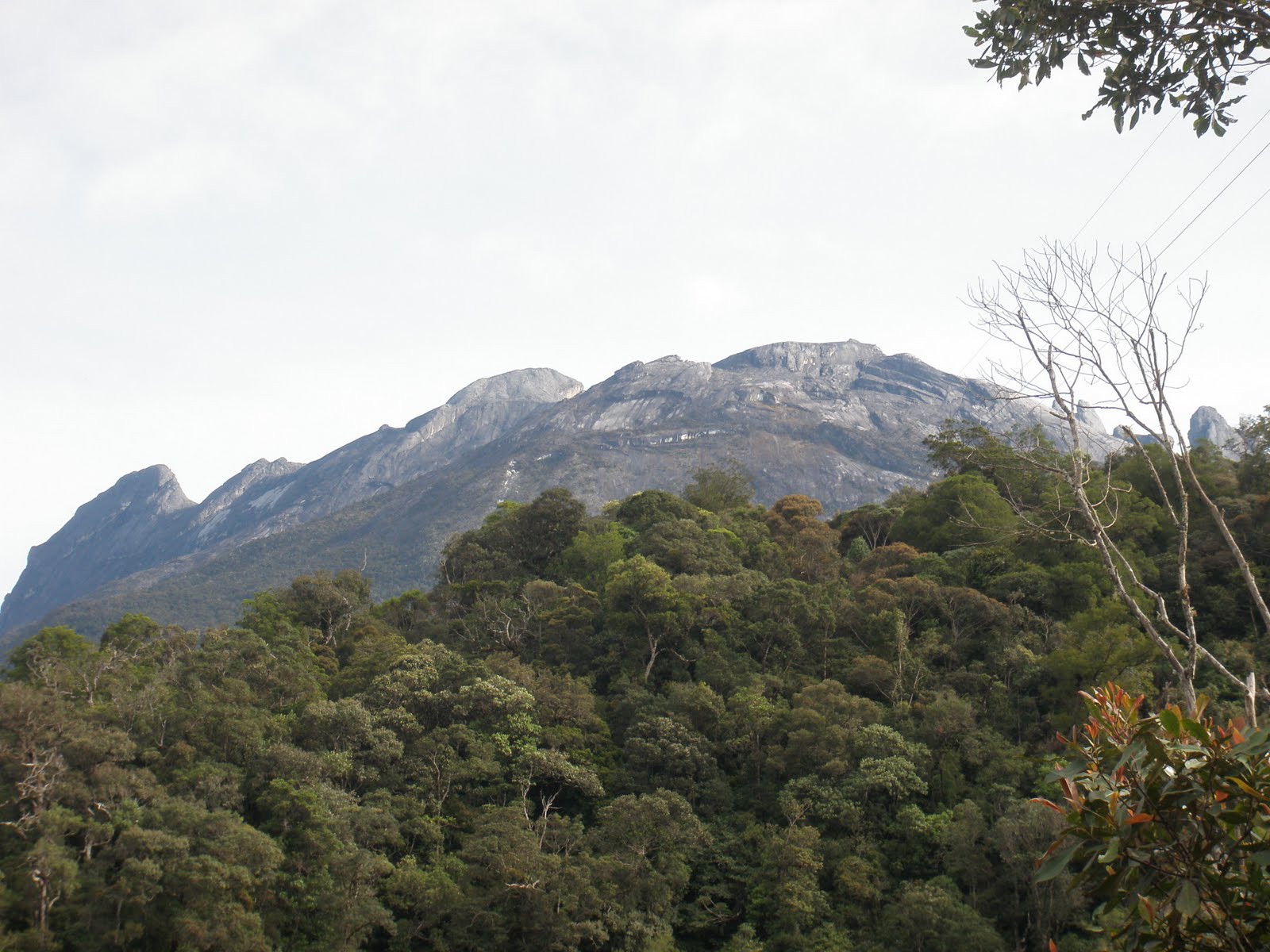
The 4th day started with journey to the Kinabalu National Park, where we were able to catch a glimpse of the infamous Mt. Kinabalu with a panoramic view of it. We then adjourned to Kudat, towards Pantai Kelambu and Tg. Simpang Mengayau. The former beach is distinctive as a small hill being sandwiched in between two bays of the beach, which make it looks like an island in the middle of the sea. The latter is where the Tip of Borneo is situated, a place where South China Sea meets the Sulu Sea, and from here, one can see the complete breathtaking view of coastline and beautiful sunset. On the next day, before heading back to KK, we stopped over at the Rungus Longhouse in Kg. Bavanggazo. Supposing there should be some traditional and music dance performance by the natives there, but I’m not sure if we were there on the right time, because it seemed quite deserted. =.=

The best parts of the whole trip were the Larry and Vince’s Farmstay in Inanam and island hopping at Tunku Abdul Rahman Park. The farmstay is located at Kg. Sinulihan, quite a secluded area which I guessed only the locals are familiar with. The place used a self-acclaimed "Village Concept" Wooden House, surrounded by nature forest. It looks like a typical farm from the outside as we were greeted by chickens, ducks, swan and several dogs. A total of nine fishing ponds are available for the guests to fish for their dinner. Don’t get it wrong, you will still get your dinner even there’s no luck in fishing!! Haha……Fishing is not difficult if you have the patience. Even a greenhorn like me also can catch two. Muahahaha. But I’m reluctant to do it again because it made me kind of sinful……>.<

The Tunku Abdul Rahman Park consists of a cluster of islands, including Manukan, Sapi, Mamutik, Sulug and Gaya. We only hopped on to the first two, as they were highly recommended. All of my “first time” happened right here – parasail, jet-ski, banana boat and fly fish. I was trembling with fear prior to each of those watersport activity because I’m critically an acute aquaphobic, a terrified non-swimmer who always has the thought of not being able to get out of the water once I got in!! But it was really a fun-filled excitement with a truly indescribable feeling. I would definitely go for it again (except for the banana boat, I swallowed 50 ml of sea water for that), sometime in the future, somehow. ^.^

The one disappointment that we faced was at the Lok Kawi Wildlife Park. Firstly, it started to rain as soon as we arrived there. We decided to drench through the rain to see several animals only to find that the whole Aviary Section, Reptile House and another section were closed due to maintenance, but no notices were put up. The dwelling for Orang-utans was also closed for maintenance as well. The whole of Botanical Garden was inaccessible due to the heavy rain. The animal show was cancelled too. As the rain got heavier, we embarked on a tram that took us round a small section of the park, twice, using the same road!! OMG! What’s the point anyway? The animals went hiding in their sanctuaries due to the rain; none of the animals was active. And we have to pay an additional RM2/pax for that tram. I would have suggest to the management might as well close down the whole park for thorough maintenance, once and for all. Otherwise, have some discount on the ticket. Another thing, it is wiser if some drapes or curtains can be placed over the tram to block the splattering rain. Lesson learnt: Never ever visit a zoo, wildlife or animal park or of any kind similar to this in Malaysia! You will end up wasting time, energy and money for that!!

The prices of food in Sabah can almost compete with that of KL. Nice food can only be found in KK, while the rest of the eating outlets in other areas were simply to fill in our empty stomach. Seafood is commonly available around KK, but the cheaper ones can only be found in more remote areas. The prices were half of that compared to Penang. Another famous delicacy in Sabah is the coconut pudding (puding kelapa), which is a must try. Many stalls are located in Jalan Salut, Tuaran, selling the pudding, baked coconut (kelapa bakar) and lokan (big clams) bakar. I have no preference for the baked coconut though, as it’s like drinking hot coconut juice without the taste of coconut. At the farmstay, we had a BBQ dinner, a typical kampong style fried rice and Chinese buns for breakfast, and home-cooked food for lunch. Those meals were one of the best I’ve ever had since the trip. Hahaha………

Sabah is not just a land with sun, sea, sands, hills and forest, it has lots of roundabouts too!! And do have a look out for the snooker centers in the outskirts. That's the only form of entertainment available to the residents there, I guess. Despite some minor hiccups during the trip, all in all, it was fun and pleasant, with much laughter and silly jokes going around, making it sort of entertaining as well. Thanks to all my friends who made this trip possible in the most enjoyable and amusing way. Special thanks to WTY and her bf for the arrangement of the food and farmstay, seafood galore at Gayang Seafood Restaurant, the KTV and cake at Damai Club, and guiding us to the markets, museum and chocolate shop. And also TKH’s uncle for lending his Unser to us, in which otherwise we would have to fork out another sum of money to cover for car rental.

Sunday, May 30, 2010

Entering the land of SARs (17 -22 May 2010)

Darn....it has been such a long time since my last blog, almost a year! I can only blame it on my indisputable laziness....yikes!!

This was the second time I set foot on Asia's Pearl of the Orient - Hong Kong, one of the SAR of China. I'm recalling well the very last time I wrote about my first trip to this place (about 3 years plus ago), it was a not-so-pleasant experience. See here. I pointed my fingers at the tour company's arrangement, and indeed, I was not off-centered. This time around, it turned out to be quite a fun and enjoyable ride, despite the weariness of having to walk miles of road (it's a backpacking trip after all). But, here's the catch - I can't completely deny that travelling with friends and travelling with family DOES differ a lot!! :p

The itinerary was simple:

Day 1 – Roaming the streets of Hong Kong and Avenue of Stars + Symphony of Lights

Day 2 – Disneyland

Day 3 – Lantau Island

Day 4 – Ocean Park

Day 5 – Macau

Of course, I've been to these tourist attractions, but it was never been as fantastic and laid back as this time. At least, I got to taste some of the infamous Hong Kong cuisines and snacks, a few to name actually – Curry fish balls, congee (艇仔粥, 肉丸粥), dried shredded squid, red bean pudding (砵仔糕), eggette(鸡蛋仔), sugar cane dessert (蔗汁糕), toasted bun with butter and condensed milk (奶油豬仔包), pork chop bun (猪趴包), stinky tofu (I still can't believe I ate that @__@”’), wonton noodles (this bowl was really worth the pay, about RM 10, four big succulent wontons, you'll never get that in Malaysia), HK-western style breakfast and etc.

On the average, the trip went on smoothly, except for the amber thunderstorm on 3rd day at Lantau Island. Not only it got us all wet and drenched, our schedule for that day was completely set back. On top of that, we missed the opportunity to sit in the Ngong Ping 360 Crystal Cabin, the cable car that was equipped with glass bottom. What a waste!!! But it sure did a memorable thing as I got myself a new pair of shoes later. Ahem………thanks to the rain!!

Hong Kong has one of the most well-developed and efficient public transportation in the world. The average Hong Kongers depend on all these, including their metro system (Mass Transit Railway), double-decker buses, trams, taxis and ferries for their daily travelling purposes. Comparing their MTR and Malaysia's LRT/KTM/Monorail, it's a disgrace to say that we have a lot to learn from them in terms of efficiency and punctuality. Even their buses, taxis (they stick with meters) and trams can be seen everywhere on the road, which is a real convenience. During peak hours, it's a normal sight to see the subways thronging with people, but trains that arrive at stations every 3 to 4 minutes could quickly dispersed the crowd.

Another thing that I must commend on is the public restrooms. Oh, did I mention this before? Oops, I did actually, but I can't help it, because they are way too clean not to be mentioned……XD. Firstly, they have janitors to keep those lavatories spick and span at all times and the floor is always dry, most are installed with automated flushing and hand washing system, soap dispensaries are provided, toilet papers are well-supplied and in some shopping malls, they even have plastic sheet covers and antibacterial disinfectant wipes provided. And the most important of all, it's free!!! Not a single cent has to be paid for all the facilities. Ask any Malaysian, one is sure to reply that toilets that has somebody bugging for payment before entering, is surely the dirtiest and stinkiest of them all. I hate to say that though, but that's the truth……>_<

Perhaps, that is what we call the cultural practices and the mentality of the people. Look at the restaurants and cafes around Malaysia, let alone hawker stalls; wherever there is food, insects and pests are sure to come along. Houseflies are some real menace, but you can't see them anywhere in Hong Kong, even in food outlets. Yes, and you can actually eat in peace without those irritating bugs. There are people in Hong Kong that smoke too, but they are somewhat more obedient to abide by the rules. So you can actually sit comfortably in your non-smoking zone, without having to endure the puffs from the cigarettes or be a passive smoker. In open-air places, as long as there is a non-smoking sign, nobody breaks the law. Malaysia-wise, slow slow wait lah………wait for miracles to happen. In fact the law enforcers themselves are smokers too, so just shut one eye and close another lah. Period.

I've just read in the newspaper today, reporting that the government wishes to inculcate reading habits among the citizens. It says that RM 1 million worth of reading materials would be distributed to 1000 schools nationwide, and even suggested to place books inside buses and stations for commuters. The problem is those books will either be vandalized or vanished in no time. Perhaps, we can emulate Hong Kong, whereby there are free distribution of selected newspapers (very much like The Sun, but there are tons of copies available), usually near the MTR stations. Anyhow, I think on the average, commuters in Malaysia prefer to either sleep or wander around rather than holding a book and read. That's the Malaysian culture after all, but can we really change that?? Uh……erm……hmm…………

On the last day, we embarked on a journey to another SAR of China – Macau, a former Portuguese colony. Here, we visited the well-known St. Paul ruins and head on to the gardens of Mount Fortress (Fortaleza do Monte). When night fell, we roamed the streets of Macau, entered a few casinos (Lisboa, Wynn and MGM etc.), grabbed a few bottles of free mineral water, and headed back to our hotel. For us, there wasn't really a night life in Macau as the real night life is in the casinos. But the flashing and running neon lights illuminating the buildings of casinos were really some fascinating sights, in which also signifies a city that never sleeps.

That's it. 5 days 5 nights in Hong Kong and Macau. Time to get back to my humdrum life in Nibong Tebal. My next trip: Where? When? Haven't got a clue… ʘ_ʘ